Picture this. You are finishing an email and want to sign off with “yours truly.” Then you pause. Is it truly or truely? A red line may appear under one spelling, yet you still feel unsure. Many writers hit this same wall, so you are in good company.
The doubt makes sense. Most English words that end in “e” keep it when “-ly” is added. Think of “nicely,” “rarely,” and “safely.” By that logic, “truely” looks right. It is not. Spell checkers catch the mistake, but they do not explain it.
This guide gives you the answer in seconds. After that, it explains why the confusion happens. You will see the word’s history, the spelling rule behind it, and the most common mistakes. We also cover whether British and American writers spell it differently. Knowing the reason makes the right spelling easy to remember. Read on, and you will never second-guess this word again.
Table of Contents
- Truly or Truely – Quick Answer
- The Origin of Truly
- British English vs American English Spelling
- Common Mistakes with Truly
- Truly in Everyday Examples
- Truly or Truely – Google Trends & Usage Data
- Truly vs Truely – Side-by-Side Comparison
- FAQs
- Conclusion
- Related Spelling Guides from Nexlatic
Truly or Truely – Quick Answer
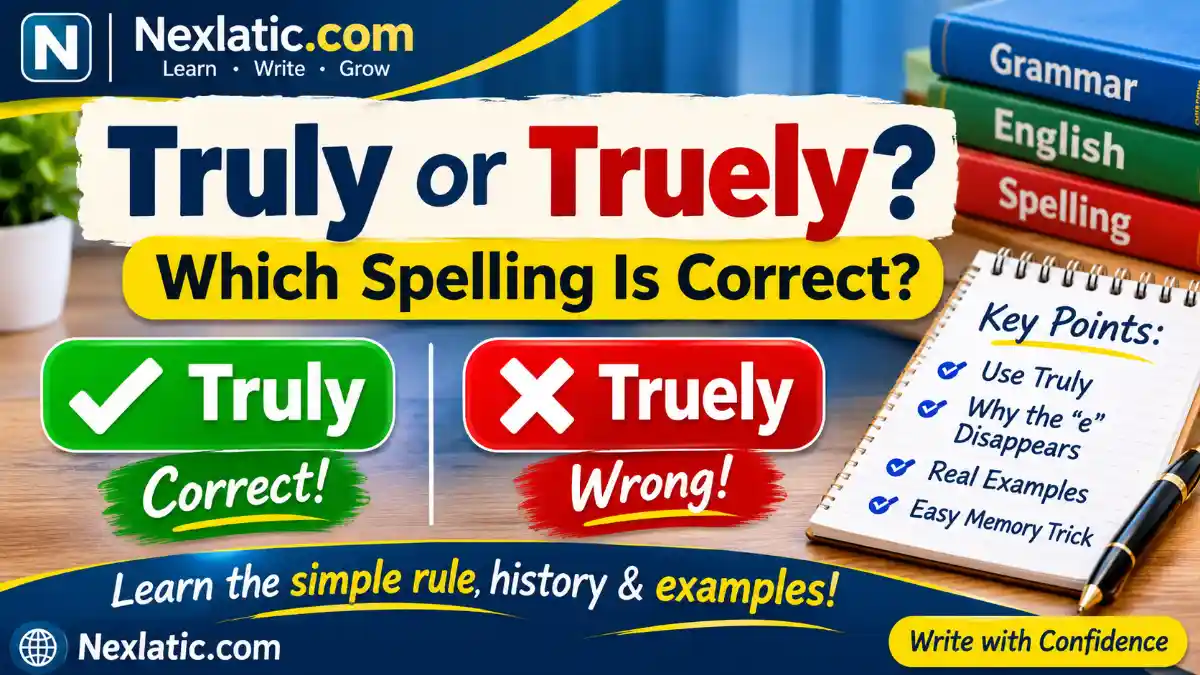
Truly is correct. Truely is wrong.
Use “truly” in every kind of writing. It means “in a true way,” “really,” or “very much.”
Here are simple examples:
- I am truly sorry for the delay.
- She is a truly gifted singer.
- We truly appreciate your help.
- Yours truly, Sam.
Here is an easy memory trick. Start with “true.” Drop the “e.” Add “ly.” You get “truly.”
The Origin of Truly
The word “true” comes from Old English. The old form was “trēowe,” and it meant faithful or loyal. Over time, the meaning grew to include “correct” and “real.”
The adverb form came from the same root. Old English added a “-lice” ending to make it. That ending later shrank into the “-ly” we use today.
Early English spelling was not fixed. Writers spelled one word in many ways. You may see “trewly” or “trewely” in old books. Printing presses and later dictionaries helped settle one standard form.
Why Does the “E” Disappear?
The “e” in “true” is silent. It does not help the sound of the word. When “-ly” was added, the “e” dropped away, and the spelling “truly” stuck.
A few other words behave the same way:
- due becomes duly
- whole becomes wholly
Most other words keep the “e,” so these few feel like rule breakers. That is why so many people type “truely” by habit.
British English vs American English Spelling
Here is the good news. There is no difference. British, American, Canadian, and Australian writers all use “truly.” No region accepts “truely.”
Many word pairs do change by region, like “color” and “colour.” This word is not one of them.
| Word | American English | British English | Notes |
| Truly | truly | truly | Same everywhere |
| Truely | wrong | wrong | Not accepted anywhere |
| Duly | duly | duly | Same everywhere |
| Wholly | wholly | wholly | Same everywhere |
| Color / Colour | color | colour | Differs by region |
The table shows the key point. Regional rules change some words, but they do not touch “truly.”
Common Mistakes with Truly
Writers make a few repeat errors with this word. Here they are, with fixes:
- Truely → truly. This is the top mistake. The extra “e” does not belong.
- Truley → truly. The “e” moves to the wrong spot.
- Trully → truly. A double “l” is not needed.
- Yours truely → Yours truly.
- Wholey → wholly. The same pattern appears here.
- Duely → duly. Another word where the “e” drops.
Notice the pattern. Each error tries to keep or move the silent “e.” The fix is always to drop it.
Also watch out for mixing up “true” and “truly.” “True” is an adjective. “Truly” is an adverb.
- Wrong: She sings true well.
- Right: She sings truly well.
Truly in Everyday Examples
In Emails
- Thank you truly for your quick reply.
- I truly regret the mix-up.
- Yours truly, Jordan Lee
In News
- The mayor said the storm was truly unexpected.
- Fans called the final goal truly special.
On Social Media
- Truly the best coffee in town.
- Feeling truly grateful today.
- This view is truly unreal.
In Formal Writing
- The report is truly independent.
- We are truly committed to fair pay.
- The author truly believed in the cause.
All of these use the same spelling. The setting changes, but the word stays “truly.”
Truly or Truely – Google Trends & Usage Data
In real use, “truly” is far more common than “truely” in books, news, and web pages. “Truely” shows up mostly as a typo in informal writing. To compare live search interest, open Google Trends and compare “truly” with “truely” for your country and date range.
Truly vs Truely – Side-by-Side Comparison
| Variation | Correct? | Part of Speech | Example |
| Truly | ✅ Yes | Adverb | I am truly happy. |
| True | ✅ Yes | Adjective | That is a true story. |
| Truely | ❌ No | Misspelling | Avoid this form. |
| Truley | ❌ No | Misspelling | Avoid this form. |
| Trully | ❌ No | Misspelling | Avoid this form. |
Related Spelling Guides from Nexlatic
- Firey or Fiery? Correct Spelling Explained Simply
- Principal or Principle: Which Spelling Is Correct?
- Compliment or Complement: Which One Is Correct?
- Woah or Whoa: Which Spelling Is Correct?
- Calfs or Calves: Which Plural Is Correct?
FAQs
1. Is it truly or truely?
The correct spelling is “truly.” “Truely” is always a mistake.
2. Why is truly spelled without an “e”?
The word comes from “true,” which has a silent “e.” That “e” drops when “-ly” is added. “Duly” and “wholly” work the same way.
3. Is truly spelled differently in the UK and the US?
No. Both use “truly.” This word has no regional spelling.
4. Is “yours truly” correct?
Yes. It is a common sign-off, especially in American letters. British writers often prefer “Yours sincerely” or “Yours faithfully.”
5. Is “truely” ever correct?
No. You may see it in very old texts, since early spelling varied. In modern English, it is an error.
6. What other words drop the “e” before “-ly”?
“Duly” (from due) and “wholly” (from whole) are the best-known ones.
7. How can I remember the right spelling?
Think “true, drop the e, add ly.” Then you get “truly.”
8. Can I use truly in formal writing?
Yes. It works well in essays, reports, and business letters. Use it to add emphasis, but do not overdo it.
Conclusion
The answer is simple. Truly is the correct spelling, and truely is always a mistake. No exception exists in British, American, or any other English.
The confusion comes from a common rule. Most words keep the final “e” before “-ly,” but “true” drops it. Due and whole follow the same pattern, becoming “duly” and “wholly.” Once you know this small group, the spelling gets much easier.
Remember a few key points. Use “truly” in emails, essays, news, and social posts. Pick “Yours sincerely” or “Yours faithfully” for formal British letters, and “Yours truly” for many American ones. Run a quick check if your fingers type an extra “e,” since spell checkers usually flag it.
Here is a memory trick. Take the word “true,” drop the “e,” and add “ly.” That gives you “truly” every time.
Now you can write with confidence. Share this guide with a friend who still wonders, and bookmark it for the next time doubt appears.

David Wilson is a writer and contributor at Nexlatic.com, where he writes about useful topics, everyday questions, and practical ideas. He enjoys turning information into simple, clear, and easy-to-read articles that readers can actually use. Through his work at Nexlatic, David aims to share helpful content that answers common questions, explains confusing topics, and gives readers something useful to take away from every article.





3 thoughts on “Truly or Truely: Which Spelling Is Correct? (Quick Answer + Examples)<p class="post-updated-date">🕓 <span class="updated-label">Last updated on</span> <time datetime="2026-11-01T14:36:53+00:00">November 1, 2026</time></p><script type="application/ld+json"> { "@context": "https://schema.org", "@type": "BlogPosting", "mainEntityOfPage": { "@type": "WebPage", "@id": "https://nexlatic.com/truly-or-truely/" }, "datePublished": "2026-11-01T14:36:52+00:00", "dateModified": "2026-11-01T14:36:53+00:00" } </script>”