
Picture a quick email to your boss. Halfway through the sentence, you stop. Is it “accept” or “except”? Millions of people pause at this pair every year, so you are in good company. The two words look almost the same. They sound close too, especially when we talk fast. That is why people search for “accept or except” every day. Readers want a fast answer, and they want to trust it.
A single wrong letter can flip your meaning, and it can make a good message look careless. Writers, students, and busy workers all make this slip. Here is the good news. These words mean very different things. Once you learn one simple trick, you will not mix them up again.
This guide gives you the quick answer first. Next, it shows where each word came from. After that, we look at British and American English, common mistakes, real examples, and usage data. A short FAQ closes things out. Let us clear up the confusion for good.
On this page
- Accept or Except – Quick Answer
- The Origin of Accept and Except
- British English vs American English Spelling
- Which Spelling Should You Use?
- Common Mistakes with Accept or Except
- Accept or Except in Everyday Examples
- Accept or Except – Google Trends & Usage Data
- Accept vs Except: Side-by-Side Comparison
- Related Spelling Guides from Nexlatic
- FAQs
- Conclusion
Accept or Except – Quick Answer
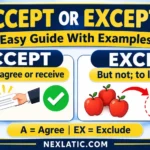
“Accept” is a verb. It means to take, receive, or agree to something. “Except” means “but not” or “other than.” It leaves something out.
Here is the fast rule:
- Accept = say yes
- Except = leave out
Look at these examples:
- I accept your invitation. (I say yes.)
- Everyone came except Sam. (Sam did not come.)
- She will accept the job. (She says yes to it.)
- The shop opens daily except Sunday. (Sunday is left out.)
Here is a trick. “Accept” starts with A, like “agree.” “Except” starts with EX, like “exit” and “exclude.” Try swapping in “but not.” If it fits, choose except. Otherwise, choose accept.
Try one more: “I will accept all the gifts except the red one.” The first word means yes, while “except” means but not.
The Origin of Accept and Except
Both words come from Latin. They even share one root, “capere,” which means “to take.”
Where “Accept” Comes From
The Latin word “accipere” joined “ad” (to) with “capere” (take). It first meant “to take to yourself.” Old French “accepter” carried it into English in the late 1300s. Today, it means to receive, agree to, or approve.
Where “Except” Comes From
Latin “excipere” joined “ex” (out) with “capere” (take). It meant “to take out.” English picked it up around the same time through Old French. Over the years, “except” grew into a word for “but not.”
Why the Two Words Look and Sound Alike
Both end in “-cept.” Fast speech blurs the first sound, so the words land close together in our ears. Only the opening letters differ: “ac-” versus “ex-.” That small gap causes most of the mix-ups. As for spelling differences, there are none. British and American writers spell both words the same way.
British English vs American English Spelling
Here is the short answer. British and American English spell “accept” and “except” the same way. No regional rule changes them.
| Word | American English | British English | Meaning |
| Accept | accept | accept | to receive or agree |
| Except | except | except | but not; to leave out |
| Acceptable | acceptable | acceptable | good enough |
| Acceptance | acceptance | acceptance | agreement |
| Exception | exception | exception | something left out |
| Exceptional | exceptional | exceptional | far above normal |
Other pairs do split by region, like “color” and “colour.” This pair does not. Your choice depends on meaning only.
Related words match too. Acceptable, acceptance, exception, and exceptional look the same on both sides of the Atlantic. Speakers in both places say the two words in a similar way, which is why the mix-up happens everywhere.
Which Spelling Should You Use?
Pick the word by meaning, not by country.
US Readers
American readers expect the same spelling you see here. Use “accept” to agree or receive. Use “except” to leave something out.
UK and Commonwealth Readers
Readers in the UK, Australia, India, Pakistan, and Canada use the same two words. Nothing changes, so you can write without worry.
Global Audience
For a worldwide audience, keep the words simple. Choose “accept” when you mean yes. Pick “except” when you mean “but not.” Skip the rare verb form of “except,” because many readers do not know it.
In formal writing, “with the exception of” works, but “except” is shorter and clearer.
Common Mistakes with Accept or Except
Most errors come from a quick typing slip or a blurred sound. Here are the top ones.
| Wrong | Right | Why |
| I will except your offer. | I will accept your offer. | You mean yes. |
| Everyone accept Maria came. | Everyone except Maria came. | Maria is left out. |
| She was excepted into college. | She was accepted into college. | The college said yes. |
| We are open daily accept Monday. | We are open daily except Monday. | Monday is left out. |
| I accept the package tomorrow. | I expect the package tomorrow. | You mean “think it will arrive.” |
Read your sentence out loud, then swap in “but not.” That check catches most errors.
Accept or Except in Everyday Examples
In Emails
Emails often use “accept” for apologies, offers, and invites. “Except” shows up in hours and rules.
- Please accept my apology for the late reply.
- Our office is open every day except Monday.
In News
News stories use both words in short, clear lines.
- The council voted to accept the new budget.
- Trains ran on time except for two on the north line.
On Social Media
Posts are quick and casual, so slips happen often.
- Accept all cookies to continue.
- Loved every song except the last one.
In Formal Writing
Reports and letters need exact words.
- The board will accept applications until May 1.
- All staff must attend, except those on approved leave.
Accept or Except – Google Trends & Usage Data
Google Trends shows how often people search a term. Interest in “accept or except” often rises when school starts and when job season heats up. Students write essays, and workers answer offers and emails. Searches come from many English-speaking regions, including the US, UK, Canada, Australia, India, Pakistan, Nigeria, and the Philippines. Learners of English often search for near-sounding pairs like this one.
Where Each Word Shows Up
“Accept” appears in offers, cookie banners, payments, and apologies. “Except” appears in store hours, rules, and lists of things left out.
How to Check the Data Yourself
Open Google Trends and type both words. Compare them by region and by time. Then check “Related queries” to see what people want to know most.
Accept vs Except: Side-by-Side Comparison
| Word | Type | Meaning | Example |
| Accept | verb | to receive or agree | I accept the offer. |
| Except | preposition | but not | Everyone left except Ali. |
| Expect | verb | to think something will happen | We expect rain. |
| Exempt | adjective | free from a rule | Kids are exempt from the fee. |
| Acceptance | noun | the act of agreeing | Her acceptance made us happy. |
| Exception | noun | a thing left out | Monday is the only exception. |
Related Spelling Guides from Nexlatic
Confusing word pairs trip up even careful writers. These guides explain them the same way.
- Gage or Gauge: Which Spelling Is Correct?
- Moulding or Molding: Which Spelling Is Correct?
- Fourth or Forth: Which Spelling Is Correct?
FAQs
Is it accept or except?
It depends on your meaning. Use “accept” to receive or agree. Use “except” to say “but not.”
What is the simple difference between accept and except?
Accept means say yes. Except means leave out.
Is there a British vs American spelling difference?
No. Both countries spell the words the same way.
How can I remember which word to use?
Think A for agree and EX for exclude. You can also swap in “but not.” If it fits, use except.
Can “except” be a verb?
Yes, but it is rare. It means “to leave out.” Most people use it to mean “but not.”
Is “except for” correct?
Yes. “Everyone passed except for Tom” is fine. “Except” alone is shorter and works just as well.
Is “expect” the same as “except”?
No. “Expect” means to think something will happen. It is a different word with a different meaning.
Conclusion
You are typing a quick email, and your fingers freeze. Should it be “accept” or “except”? One wrong letter can turn “I accept your offer” into a line that makes no sense. This tiny pair trips up students, workers, and even skilled writers every single day.
That is why so many people search for “accept or except.” The words look alike, and they sound close when we talk fast. Readers want a quick answer they can trust, and they want it now. They also want to know the reason behind the rule, so the choice sticks.
Here is the good news. The two words mean very different things, and one simple trick keeps them apart. In this guide, you will get the quick answer first. Then you will see where each word came from, how British and American English treat them, the most common mistakes, and real examples. By the end, the confusion will be gone for good.

Ali Bismal is the founder and writer behind Nexlatic.com, a growing online platform created to provide useful, informative, and easy-to-understand content for everyday readers. Through Nexlatic, Ali shares practical ideas, helpful guides, interesting topics, and engaging articles designed to make information simple and accessible. His goal is to create reliable, reader-focused content that helps people learn something new, find useful answers, and make everyday life a little easier.








1 thought on “Accept or Except: Which Word Is Correct? (Easy Guide)<p class="post-updated-date">🕓 <span class="updated-label">Last updated on</span> <time datetime="2026-11-06T13:08:04+00:00">November 6, 2026</time></p><script type="application/ld+json"> { "@context": "https://schema.org", "@type": "BlogPosting", "mainEntityOfPage": { "@type": "WebPage", "@id": "https://nexlatic.com/accept-or-except/" }, "datePublished": "2026-11-06T13:07:58+00:00", "dateModified": "2026-11-06T13:08:04+00:00" } </script>”